
Finding her pace
Klaudia Kazimierska came to Eugene four years ago in search of a reset. After her first pro season, she feels she’s found it.
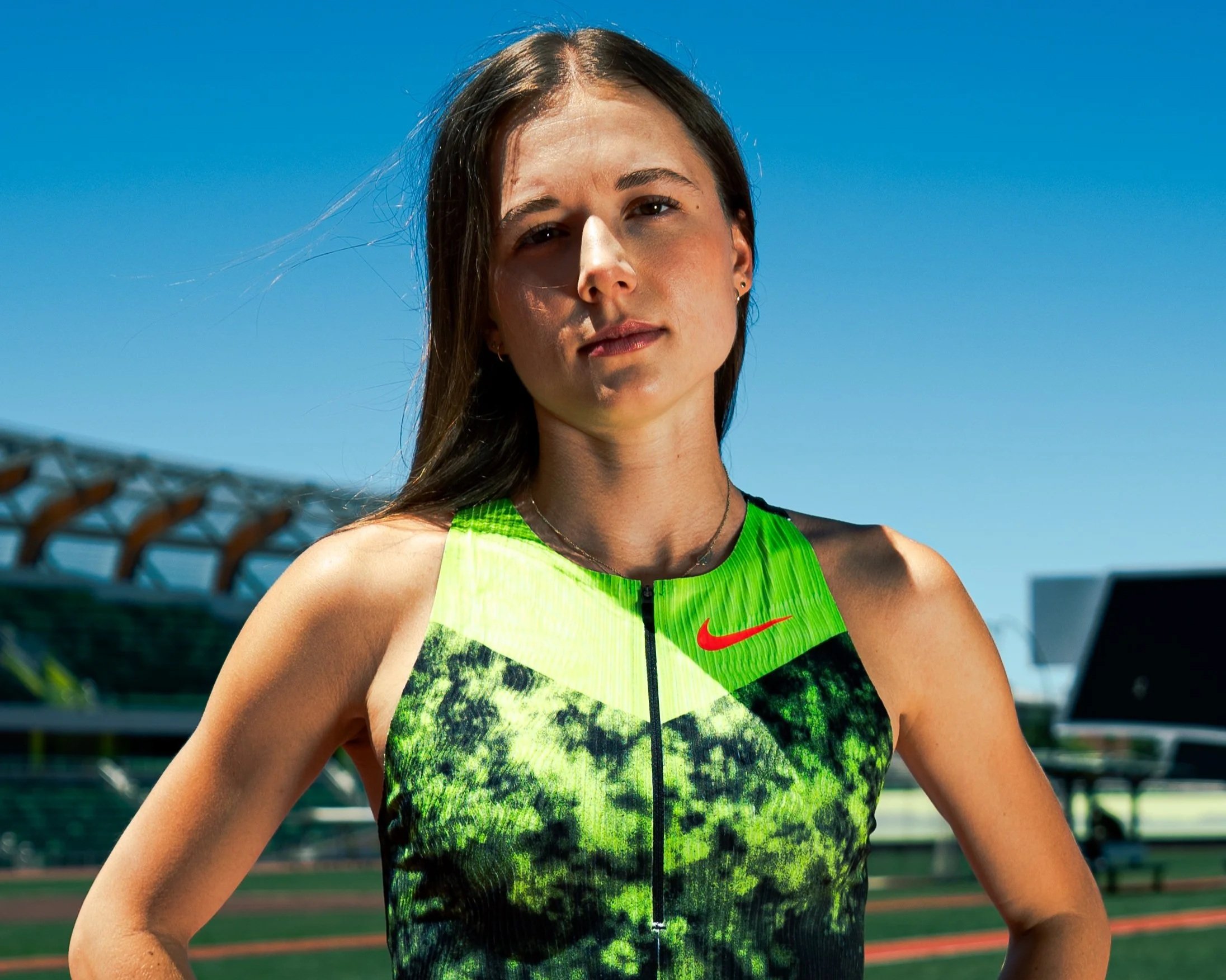
By Owen Murray
Shalane Flanagan’s phone buzzed with a question.
“Can you call me?”
Flanagan is one of the world’s most accomplished distance runners. She’s based in Eugene, Oregon, where she splits time as a coach between the Ducks’ track and field program and Swoosh Track Club alongside Jerry Schumacher. She is the daughter of a former marathon world record holder and a national cross-country qualifier.
This text, though, was coming from another kind of daughter, and an ocean away.
On March 22, 2026, Klaudia Kazimierska opened her phone to message Flanagan one day after the 1500m final at the World Indoor Championships. She’d run in front of a home crowd in Poland, alongside an eight-person field which included Jessica Hull, Georgia Hunter-Bell and Nikki Hiltz. It had been eightmonths since the 24-year-old Pole signed her first professional contract, with Nike, and she had wanted a medal.
Call it greedy. She calls it ambitious.
Instead, she finished sixth.
That’s why, the next day, she texted her coach, who called right back worried about an emergency. Instead, Flanagan got the voice of a runner whom she considers closer to a daughter, dissatisfied after the highest-placing international performance of her career, belabored by bigger expectations, needing to clear the air with a laundry list of dislikes and perceived mistakes.
“I need you to help me,” Kazimierska said.
Fouryears separated those six words and Kazimierska’s decision to leave Poland for the U.S. She conquered that divide and graduated from Oregon as an Olympic finalist and an extroverted teammate who was more likely to need reeling in than convinced to give slack. What’s next, though, came what Flanagan says is the harder transition of the two. By the time she turned pro, Kazimierska was an Olympian with the world at her feet, but that world was gaping wide and satisfaction still ran away from her.
“I was like, oh damn, I need to figure out everything about myself,” she says.
When Kazimierska moved across the world, it wasn’t just because Oregon felt right. In 2022, she was 20 years old and talented but mentally burnt out in Poland, at her “lowest low,” she says. Eugene wasn’t just a new opportunity; it was what she saw as a last chance to be the kind of runner she wanted to be.
“It was just like a cycle of not running well, being sad, then running slow because I'm sad,” Kazimierska says. “It was just a never ending loop.”
At Hayward Field, she found something new. Kazimierska came to Oregon a week before her 21st birthday toting a 4:07.47 1500m personal-best from 2020, but it proved more baggage than rocket booster.
She expected big results every time, and when she didn’t get them, it fed a fear of failure. Sometimes, she enjoyed training. Others, she felt bogged down by anxiety. The fears — of a bad workout, or of disappointing her teammates, didn’t feel like herself. She couldn’t explain them. She’d been working with a sports psychologist in Poland, and added one in English when she came to the U.S. to try to figure it out.
Traditionally a middle-distance runner, Kazimierska tried adding cross-country and 3000m indoor races as a Duck. She started to hyperventilate, to breathe so hard that she felt overwhelmed even though those distances hadn’t changed from training. Over her regular distances, she shook off tactics and sat at the back of the pack.
“I was just doubting myself to the point that I was just not even putting myself in a position to achieve anything,” Kazimierska says. “I think I was just literally sabotaging myself in those races because I was just not confident at all.”
In December 2023, the middle of her sophomore season, Kazimierska went back home to Poland for the holidays. She returned with a reset mind and split 3:15.73 running from the front in a DMR in Arkansas, a result which she thought was totally beyond her at the time. After a seventh-place mile finish at NCAA Indoors, instead of going out to dinner, she sat in the hotel with Flanagan, who had dealt with anxiety in college, too, and Schumacher to put the pieces together.
Five months later, in the outdoor 1500m preliminary round at Hayward Field, she solved the puzzle with a 4:06.92 race. It was her first personal best in the event in nearly four years.
“From there, I was like, ‘Okay, I'm not stuck with my 19-year-old girl Klaudia PR,” Kazimierska says. “I'm already beyond that.”
Soon, she was sprinting beyond it. Over the summer, she ran under the Olympic standard for the first time: 4:01.89 back at home in Poland; then took Poland’s national title. In the Paris preliminaries, she clocked 4:03.49 to book her place in the Olympic final.
On the track at Stade de France in Saint-Denis after that qualifying time, she found a little bit of home. Jessica Hull, a former Duck, was in, too.
“Realizing with each other that we made the final was pretty special,” Hull, who finished second in the final, says. “I think there’s always that connection, that piece of strength, because we’re both Ducks. You want to see each other succeed.”
After the Olympics and a final where she finished 10th in another personal-best time (4:00.12), Kazimierska was asked if she’d turn pro. Her stock was high, and she’d flashed the talent needed to run on the Diamond League circuit. Her answer was easy.
She wasn’t ready to leave, didn’t feel mentally prepared to move on and had no desire to run away from her new home in Eugene. She stayed, but an adductor injury in December 2024 derailed her year and erased her indoor season.
She won the Big Ten outdoor 800m title, but weeks later at the national championship meet, her nose was stuffy on the eve of the 1500m final. She was sneezing after heats — so bad that people thought she had allergies. The day before the final, she tried acupuncture on her sinuses to try to solve the issue. It didn’t work. She could barely breathe.
Her parents had traveled to Eugene for the first time to watch Kazimierska race and graduate. Grumpy and annoyed with her race, she finished fifth.
“I wish I enjoyed that moment a little bit more,” she says. “You get this opportunity just a few times, but you have that one last race as a Duck only once.”
The day after Kazimierska signed her Nike deal — July 5, 2025 — she ran for the first time as a professional. She lined up at Hayward Field. She led the women’s 5000m field through fourlaps. Then she stepped off near the tower opposite the finish line. Later, her result would flash on the board: DNF.
She’d done her job: to pace Kenyan star Beatrice Chebet to a new world record in the event. There wasn’t a competitive surge; instead, before the race came a twinge of disappointment.
She’d paced well. Chebet ran her world record. But as Kazimierska walked the 200m from the corner where she’d stepped off to the tunnel, something began to happen.
The crowd — her crowd — began to applaud her.
Hi Klaudia!
Good job pacing!
“I was like, ‘Next year, I’m definitely racing,” she says.
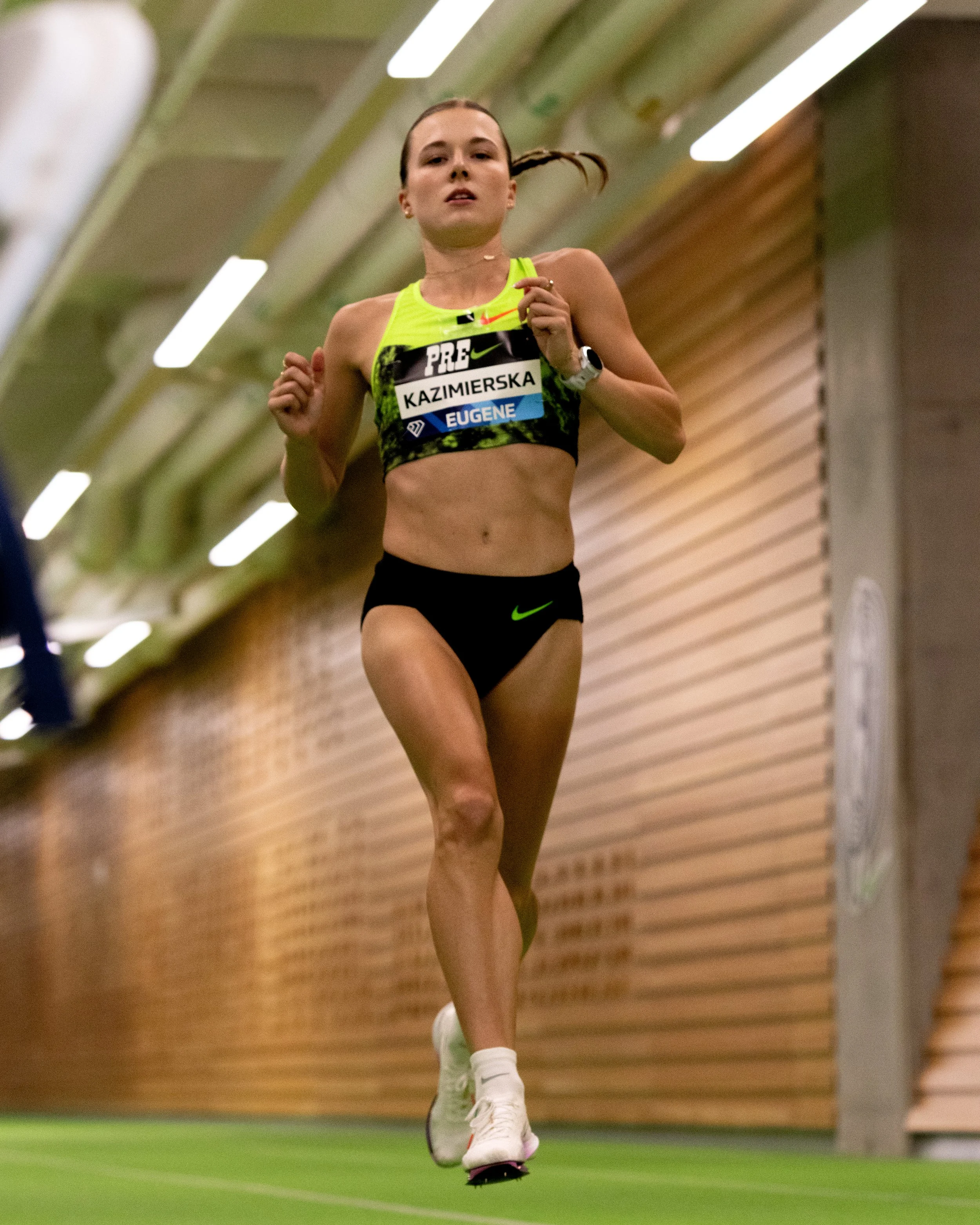
One year later, Kazimierska was talking about a Prefontaine Classic pacer again. Just before she entered the call room tent for the women’s mile, Flanagan had a question for her.
“Okay, so that you don't need to make a decision in the race, if they don't go with the rabbit, what are you gonna do?” Flanagan said. She didn’t want Kazimierska to have to make the decision on the track.
“We're just competing,” Kazimierska said.
The field was familiar: Hull, Hiltz and Hunter Bell were all on the line. When the rabbit went ahead and the leaders didn’t follow, Kazimierska didn’t panic. She stayed with the pack at the bell.
“I was like, oh damn, I can win the race,” she says.
World record holder Faith Kipyegon led the charge down the home stretch. Kazimierska surged, then trailed Nikki Hiltz, who powered past the pack. Kazimierska finished fourth, in a Polish record 4:17.90, one year to the day since she signed her deal.
“I came out here thinking that I want to close this first year here very well and open the second one, and I think I couldn't get a better first year as a pro,” she said afterward. “I'm just going up slowly — small steps, you know. You're gonna eat with that little spoon to stay hungry all the time.”
Every month when her group trains on the bike path in Eugene, she starts to think, I'm so bad at this. I'm having one of the worst workouts in a while. Once, she got dropped by 10 seconds. Schumacher rode by on his bicycle: Good job! You’re doing great. His joy — his stories he has to tell — is why training often starts a quarter-hour late.
“Each person needs different things to feel not lonely or to feel successful, and it's kind of them figuring out what they need to feel fulfilled and happy and make this a sustainable lifestyle,” Flanagan says. “And that, I think, was the bigger jump, honestly. Instead of from high school to college, what I found to be harder was the jump from collegiate to pro.”
Two weeks before The Prefontaine Classic, Kazimierska fell off the pace on a training run. Schumacher followed the lead group ahead. Flanagan stayed back. As they turned around to cool down, Kazimierska wasn’t breathing hard. She was talking to her coach, about why she felt good, about why she didn’t feel that she needed a perfect workout to feel satisfied.
Now, she comes home to her cat, Klu. She weaves metaphors about dissatisfaction, ending by saying, “If you want it, you will get it, because you're not going to sleep peacefully if you don't.”
The day before the women’s mile, she sat on the track for a little while after her practice at Hayward Field. She felt “jittery and overstimulated” as she walked home, and slept there instead of a hotel.
“That’s a good sign,” she says.